Saturday, 14 September 2013

The Queen o't'owd Thatch

While not reading books and failing to get round to blogging about them I often find myself on a bike riding about North Yorkshire generally on the way to,  or the way back from a pub. And it has come to my notice that there is a peculiar cluster of gastropubs (no, mister predictive text, I did not want to say gastropods, even though there are plenty of the about as well) north west of York.
There's the Dawnay Arms at Newton on Ouse, and a little past that the Crown at Great Ouseburn, which is rather wonderful, even if they haven't got anywhere to park a bike. There's the Durham Oxford at  Crayke and apparently a new place at Lower Dunsforth, which I shall try at some point. There's obviously something in the water, or perhaps that bit of land more or less equidistant from York, Rippon and Harrogate that means people all head there when fancying a drive out, a drink and a nice meal.
Now I like these places. All do good food, most do good beer, all provide a nice bike ride to get there, and all of them are rather in the wrong direction to meet up with most of my friends, who tend to live to the south.
So where are the other good foodie pubs? You would have thought that if the York / Rippon / Harrogate triangle would keep so many going them there would be a similar cluster between York and Leeds, but they seem far less common.
Discussing this at work a friend suggests the improbably named Queen o't'owd Thatch, in South Millford. Checking the maps, it's about 20 miles, it's a surprisingly nice and sunny day, so why not?
I'm here for lunch on a Saturday, and perhaps a bit early - I don't think there are any other customers in when I arrive, though some are trickling in as I write this. It's a nice open place with a large dining area and only a few more pubbish tables to one side. Definitely good attentive staff, which of course may be a side effect of not having many people in to attend to.
Impressions: you often find that foodie pubs are a little less imaginative when it comes to be than the food and wine, which might be the case here. Leeds Pale, York Terrier,  Ossett Blonde. All good reliable drinks, even if none of them are surprising. Nice to get the beer in a proper old fashioned mug with a handle. I don't know many places that still use them. Are they more expensive? Do they take up too much space in the dishwasher?
The QoTT obviously does think about the wine a lot, since the menu suggests a type ideally paid with every course, which I am strenuously ignoring in favour of beer. They even have an extensive list of cocktails, with a fair number of non - alcoholic options.
As I said, good attentive staff, who check exactly how is like my beef done, and I'm pleased to have some wait for the food to arrive. There's little worse than the sense that the food was sat under a warming lamp just waiting for you to come in. And it's a good bit of beef, pink and succulent on the inside, crisp and slightly smokey on the outside. If there's a criticism then it's that I'd have liked a little more in the way of veg with it - yes, there were side dishes in the menu, but I never expect to have to think of greenery an extra. Remember that for next time. It was a very nice bit of beef,  with mash and turnips and a wonderful intense sauce, which I expect a proper good blogger would call jus.
So to contemplate desert. I don't normally go for pudding when cycling out to pubs, but there's a lemon tart calling to me and what the hell? Throw caution to the wind. And I am a sucker for a good lemon tart. And (he writes a few minutes later) that was a splendid lemon tart, sharp citrus complemented by raspberry sorbet and completely lacking in soggy bottom.
So all in all? I can't see this being somewhere on a regular pilgrimage route, but so somewhere to suggest to meet up with friends in Leeds or coming up the M1, certainly. It's not cheap, but good food shouldn't be. And it says definitely good food.

Friday, 21 June 2013

Dodger

By Terry Pratchett
Not  Discworld for a change. Second non-Discworld in the last few years now that I thinks about it,  following,  but quite unlike Nation a few years ago.
I'm not entirely sure why this isn't set in the more familiar milieu though. Nation,  taking themes from Robinson Crusoe and The Coral Island could have be said to take place on a previously unknown island in the middle of an unknown Disc sea,  but it would have added nothing. This is a Dickens pastiche, and the modern Ankh-Morepork is pretty much evolving into a  steampunk version of Victorian London as it is.  But this is the real London,  so let it be.  And if Sir Terry needs a break now and again from his well worn settings to keep things fresh,  then more power to him.
Our protagonist is not quite the slightly older incarnation of Oliver Twist's friend,  but it's close. The suggestion,  seeing as how the great novelist appears as a character is perhaps that this Dodger is the inspiration of the literary  character,  which is a bit meta for a Friday afternoon. We have here a bit of Dickens,  a bit of  Ruritanian romance,  in which an urchin saves an girl from swarthy European ne'er do wells, eventually earning the appreciation of Her Majesty, after plots,  double dealing and chases through the sewers under the streets of London.
There's honestly nothing wrong with the book.  It's a romp,  does what it sets out to do,  no point trying to read loss of drop thought into it because there wasn't any great thought in it.  Or perhaps I'm being more than normally obtuse. But let's take it as gave value. A romp.  A heroe risen from the streets,  from beneath the streets even,  with a heart of gold and no discernable flaws. All rather easy really. Perhaps that's why I felt it kind of lacking.
I applaud Sir Terry's willingness to try something new,  I just didn't really think there was enough depth to it.

Friday, 14 June 2013

Nexus

By Ramez Naam
I never really got cyberpunk.  Friends did.  Friends were terribly keen.  I vaguely know someone who still dresses in a heavy leather coast and mirrorshades in a manner nominally derived from William Gibson,  but despite there being decent scenes,  I could never be bothered to read beyond Necromancer.
This is perhaps what cyberpunk has evolved into,  and I rather enjoyed it.
Disclaimer: the book was somewhere between a gift and a bribe from the author who was trying to secure a nomination for the Hugo awards, by offering chips of his novel to anyone able to give it a nod. I do not know if such things are considered 'sporting', but I thought I should at least read the thing before allowing the bribe to work.
2040 or thereabouts. The terrorist weapons of choice by now are tailored bioweapons, especially those that allow criminals to subvert the will of innocent bystanders, nasty things that have hit America several times,  rendering the authorities deeply jumpy.
Into this we mix an innocent,  which might even be thought of as naive,  researcher who is working to transform a party drug allowing fleeting impressions of others thoughts into a permanent enhancement to the human brain allowing effective telepathy.
The descriptions of the nanotech involved are reasonably convincing,  especially given the recent stories about connecting rats' brains together (link). Kade, our naive hero is convinced that this kind of communication will bring only good to the world,  despite the repeated evidence of it being really scary shit. Two way communications are great,  but what about one mind controlling the nanotech in another's body? What if one could therefore cause someone to kill themself, or someone else?
But Kade doesn't worry about that kind of thing. Not at first anyhow. Open,  free communications,  that's the thing. Raided by the specialist anti-scary tech cops he is blackmailed into trying to infiltrate the research group of a particularly worrying Chinese academic who's work may be responsible for a wave of unexplained assassinations. So off he reluctantly trots to a conference in Bangkok,  with a buffed out handler,  who may herself be exactly the kind of post-human that she's supposed to stop. And shenanigans ensue.
There's a nice ambiguity to the book. Hardly anyone's evil,  though many are pretty irresponsible. Given the awful things some of these emergent Telford can do,  resisting them seems fairly sensible, even if their methods are extreme.  The technologists for the most part are looking to build a better future,  even if they've not much clue about the ways their tools could be subverted. Those that don't reject human culture and society in favour of the  transhuman world they aim to create.
I remember years ago working in an office that was just getting internal email for the first time,  with managers horribly worried about what uncontrolled communication might do to their sense of control.  "How will I know who's been told what?" they would say. The same conversations happen now with regard to Skype,  and must have done with telephones and telegraphs and probably the printing press. We fear the new,  until a few years later when we can't remember being without it. There's a lot in the new here to be fearful about,  but the telling is solid. The whole thing collapses into a firefight at the end which is less interesting than the socio-political questions,  but I enjoyed it.
He didn't get onto the shortlist though.

Sunday, 3 February 2013

The Scar

By China Mieville
Only the second CM I've read (more will follow) and sadly not quite as mindblowing as Perdido Street Station. But still pretty damn good.
Linguist Bellis Coldwine is fleeing from New Crozubon, having been somewhere on the edges of PSS and having seen those closer to the action rounded up and arrested, which isn't all that surprising given the problems they caused.
Sailing rather reluctantly to a new land is further spoilt by her ship's capture by the pirate city of Armada  a mobile conurbation assembled from the thousands of vessels seized over the centuries. She doesn't like being impressed, even if it is to serve as a librarian rather than, as she expected, a deck hand, not terribly surprising, and spends much of the book plotting an escape, or rather being manipulated by a Crozubonite spy captured with her, as Armada procedes on a reckless course seeking to achieve vast power by capturing an avanc, a primordial sea monster and using it as an outboard motor.
All reasonably fun and there are plenty of adventures along the way, perilous journeys onto the island of the dreaded mosquito women and into forbidden oceans while fighting off attacks from the navy and vampiric uprisings, but it never struck me as having as much to say as it's predecessor. An Amiable enough fantasy-pirate romp I suppose, but I can't see myself re-reading it. 


Sunday, 28 October 2012

Whispers Under Ground

By Ben Aaronovitch
Honestly nothing new to say. I enjoyed it, I'll be keeping an eye out for the fourth in the series. But I've already written about the first two.

Vestige

By Chris Roper
I'm rather writing this on the assumption that hardly anyone will read it. The review that is. Perhaps people will read the book, and hopefully they'll enjoy out more than I did.
Chris is someone from work, who has taken the bold step of publishing his first fiction through Amazon. In this I applaud him. Unfortunately it's a Big Dumb Object story, and it's only in thinking about how to review this and previously Heaven's Shadow that I have come to realise how much I dislike that sub-genre of SF.
The story's about a relatively near future space mission sent to deliver a mcguffin to Triton forced to make emergency maneuvers which lead it drifting out towards the Kuiper belt with no hope of rescue before discovering a mysterious black cube that may be a conduit to another universe.
So we've got the BDO problem, coupled here with the fact that of the only three characters, two are certainly insane, and the third might be. 
It's not badly written or anything, it's just starting off with all the cards stacked against it. At least as far as I'm concerned.  Your mileage may vary.
Sorry Chris.

Wednesday, 24 October 2012

Heaven's Shadow

By David Goyer and Michael Cassutt
There's an awful lot of Arthur C. Clarke to this book, coupled perhaps with Steven Baxter's NASA series.
Ten years into a what might already be an alternate future, in which the US space agency has been kicked back into a space race with an Indian-Russian-Brazilian coalition and missions to the Moore once again a going concern, an asteroid is detected making a close approach to Earth and the latest moonshot is diverted to visit it.
Not the only ones mind you, since a suspiciously well prepared coalition craft is also trying to be the first men on Keanu. Two spaceships land, as the asteroid starts to behave very oddly, revealing itself not to be a passing rock, but a star craft from who knows where.
Exploring the object reveals a cavernous interior able to create alien creatures and raise the dead, much to the discomfort of astronauts confronted by their dead wives, friends or children. There is evidence to suggest the mysterious Architects, creators of this world, whatever their motives might be, strange things in the body of the object, further in, further in.
Very Rendezvous With Rama. More immediate, more now, but very similar concepts.
I half liked it. I enjoyed the bulk of the stuff on Earth, with mission control scurrying about trying to form a sensible response to what might be an attack from the stars. Rather a sense of the whole Apollo-13 scrubbers episode, very clever men suddenly out of their comfort zones. The central astronaut was a bit dull, but well formed. In fact pretty much all the characters are well presented, rounded people, even if the American called Tea left me wondering if she had a sister called Coffee. Yes. I know Te-a.
So what was it I didn't like.
It occurs to be that there is in fact an entire Big Dumb Object sub-genre of science fiction that I don't care for. I was never that excited by Rama. Of all the Known Space books, Ringworld is the one I care least for. I know people who rhapsodise about Greg Bear's Eon, but it left me very cold. This is the same.
So you get these books and in them you haver some space explorers find a thing. What kind of thing? A big thing. An alien thing. Often involving a tunnel. So they dock/land/crash their spaceship at one end of the tunnel and weird shit starts to happen. And the further in they go the weirder the shit is. And eventually the shit gets so weird that they run back to the mothership and escape, often leaving one or two people behind.
It all becomes about exploring the unknowable. Instead of being driven, as the first half of the book is, but people and their interactions and competitions it just devolves into pushing further in and seeing how much weirdness the author can come up with. Which is generally lot when not constrained by much need for it all to make sense.
Essentially you get something formulated as a mystery, but without any ability to solve it. That lovely understanding that comes when the writer's presented their clues just right, so you grasp the plot a page or two before the hero? Impossible.
Obviously some people like this style of book. They're welcome to it.
There's a sequel, indeed I think there may even be an unpublished third volume. Unless I hear lots of people praising it to the high heavens, I think I'll give them a miss.

The War That Came Early

By Harry Turtledove
Harry Turtledove wrote at least one really good book, and increasingly I find myself thinking, only one really good book. The good book was the Guns Of the South, a time travel book in which Afrikaans supremacists, smarting at the loss of apartheid come back to 1863 and give the Confederates a whole bunch of AK47s in the hope that a victorious CSA will make a world where slavery's a going concern and so the idea of white people's 'natural' domination over the darker skinned remains acceptable into the 21st century.
It manages to present not only a rollicking adventure story, but also some fairly cogent ideas about the attitudes of the common southern soldiery, only a few of whom are fighting to keep the slaves in their place. If there's a flaw it's that pretty much everyone except the time travellers is entirely nice. It's been a while since I read it, but I seem to remember that even the founder of the Klu Klux Klan comes round to a liberal position as soon as he finds out the degree to which he's been manipulated.
Since then Turtledove's books have become increasingly long winded, formulaic and plain Alternate History, lacking any time travel elements. A twelve volume history of a (different) victorious South as it slides throught the first and second world wars is a fine example of his current style, which seems to involve less speculation that one would really like, and rather more taking real events and putting a gloss over them. So a corporal in the defeated southern army comes to lead a party devoted to getting his nation back on it's feet while ensuring that the traitors who stabbed them in the back get sent to camps. Negroes rather than Jews, artillery rather than infantry, but it's not a clever bit of parallel, it's just recasting. The whole series was full of that, be glad that I am not going to go on.
Sometimes this style can work, but generally only when things are kept snappy, which is to say, kept to a single book. I quite liked the one about the few surviving Jews in a post Hitler reich, but at the point it became clear that the big events were all glasnost/Yeltsin then it became predictable, and all the suspense was left hanging on who'd win a game of bridge, a challenge for even the best writers. And being honest, Turtledove is not one of the elite.
So here we have what looked at first like it was a snappy-ish pair of books positing a second world war starting with Chamberlain standing up for Czechoslovakia. Oh and someone other than Franco running the Fascists in the Spanish Civil War. If these two events are connected then I've not grasped why.
To get the good stuff out of the way: the books bounce along at a fair old pace. They're not demanding, not trying to be. There's also a pleasing preparedness to kill off viewpoint characters. No-one is safe.
Unfortunately the bounce along just helps show up the author's weaknesses. There's a strange sense that each section is there to establish a single point. God knows it's not characterisation. All his characters talk exactly the same, all have the same annoying little tics. There really is the sense that the book starts off as a Word document plan and just gets filled in. Do all writers work that way? Most don't make it that obvious.
And then there's the dread that occurs about three quarters of the way through the book. Oh Lord, there's too much still to wrap up. There's that character who's been hanging about for two books and done bugger all. This isn't a snappy two parter, it's another bloody extended opus. More of this rubbish.
Thank God they were library books, I'd hate to have paid for them.

Hit Man/Hit List

By Lawrence Block
I can't remember the last time I discovered a new writer through a book.  Especially not a book written on bits of dead tree. Still reading,  rather faster than I'm writing them up for here,  but I'm just not picking up the odd speculative paperback like I used to.
Where I am starting with new writers it's through podcasts,  particularly Starshipsofa and its entourage.
One of these podcasts launched a few months ago with a rather fine story by Block about a hit man hired ostensibly to kill an especially annoying dog. Nice story. Enough to make me hunt down more of the same.
The first is a collection of short stories,  the second has far more narrative, but still does it's short fiction roots. Surprisingly light,  all told with an appealing deadpan sense of humour. On the list of writers to come back to.
The thing that's bugging me though,  and no answer is available,  is whether these were books my late grandfather read. He did read American crime fiction, lots of it, and while he wouldn't have been about for these books, too recent, Block's been writing for ever. Perhaps there were shelf loads of them, making him a writer I really should have been reading for decades.

Wednesday, 4 July 2012

Zoo City

By Laurel Beurkes
I've been dithering over this one. The book is good. Lets get that out of the way. Addressed as a mildly post-apocalyptic detective story it works, it flows, it would be well worth reading.
The heroine is seriously flawed, but remains engaging. Her long suffering sloth familiar is one of the most entertaining such creatures out there, easily the nicest beast one might be lumbered with since Pantelimon, though he is certainly less talkative. But what would you expect from a sloth?
So in short: if you're in the mood for a thriller set against a collapsing South Africa where criminals and outcasts are marked by the appearance of a mystically linked but otherwise normal animal, then this could be the book for you. Buy the book.
You might want to think about it a little longer if you're the looking out person who worries about just why people might fund themselves saddled with an animal just because they've stepped outside human norms. There's obviously something supernatural going on, but no-one knows just what. All that matters is that 15 our so years ago people stayed getting animals and with them abilities that feel like, and might even be, minor magical powers.
Like most magical realism that kind of thing kindly bothers me if done badly, and here it's not.
So why am I dithering?
It's South Africa. I don't know how to think about it these days. I don't know what degree of metaphor is here employed.
When I was a kid South Africa was simple. The nasty white people were dominating the blacks, and if only they started paying attention to the Special AKA then it would have a much nice place. And then they let Nelson Mandela out, they won the rugby and it was.
All very simple. Too simple, I know. And it's all got more complicated since then as increasingly less saintly presidents come and go and the stories about rampant criminality grow and grow and one comes to see just why the modern South Africa might feel like a post-apocalyptic wasteland. But probably line where not recent the most hardened criminals get a sloth.
But is that what the author intended? Or just my trying to second guess her motives? I don't know and that worries me. And so I dither.
Good book though. Well worth making your own decision.


Saturday, 30 June 2012

Goblins

By Philip Reeve
I think I wrote about Philip Reeve before, lauding his young adult steampunk books.
Same writer, but this is aimed at a rather younger audience, his eight year old son was mentioned, and I didn't really get as much from it.
It's a nice enough book, don't get me wrong. The hero is a too clever by half goblin exiled from the half forgotten ruins of Mordor. He is supported by an amiable cast of cheese-makers turned would be heroes, abducted, and perfectly happy with it, princesses, accountants  who fancy themselves sorcerers plus assorted monsters.
Something the younger me would have enjoyed entirely, something the current me found a little too slight. Which given that I'm on the order of thirty five years older than the target audience isn't really the most surprising thing in the world.
Apparently the people that turned Coraline into a movie are planning on filming this in the next couple of years. I shall look forwards to it.
Meanwhile I shall look for someone of an appropriate age and pass the book on.


Geek Tragedy

By Nev Fountain.
So there I am, contemplating going to an SF convention for the first time in my life and I read this. Enough to make one steer well clear, though it is possible that this is not entirely representative.
Not actually science fiction, though rooted in SF culture, this is the story of a retired script editor attending a convention for the first time in years, and is written by a script editor who may or may not be retired. The hero is a reluctant detective who punches well above his weight with the ladies, in particular the somewhat ghastly female lead of his dreadful show. The author is apparently in a relationship with an eighties Doctor Who companion, whether he is also prone to occasional bits of detective work is not known, but I can't shake the suspicion that incidents are drawn from life.
Nev Fountain is a writer I have issues with. He was associated with two of my all time least favourite Doctor Who stories, as script editor on the dreadful Death Comes To Time, and writer of a Big Finish story involving little old lady Time Lords that just rubbed me up the wrong way. I went into the book very happy to hate it.
And it surprised me.
It's actually a pretty good book.
It might even be a very good book.
It's not high art, but it makes no attempt to be so. It's a romp, and pretty much every romp target is hit. It helps of course to be reasonably sympathetic towards somewhat cringeworthy Eighties TV, but deep down the geek stuff wouldn't be worth a damn if the detective story wasn't well told.
And it was.
I don't normally go into any depth about where to buy books, but it's worth noting that Amazon would like one to pay £7.50 or thereabouts, while BooksOnBoard are happy to sell it for half that. Just hoping that they're legit and the author will actually get their deserved royalties.

Friday, 22 June 2012

Full Dark House

By Christopher Fowler
The adventures of Bryant & May, detectives with the Metropolitan Police's Peculiar Crimes Unit, sounds like it should be in the same kind of supernatural cop space occupied by Ben Aaronovitch, or, given that Arthur Bryant apparently dies in an explosion shortly before the start of the first book in the series, Randal and Hopkirk (deceased).
Alas it's not.
We have here a rather cleverly constructed novel set in two periods, the unit's first case in 1940, the surviving detective's investigations in... not entirely clear, but they have mobile phones and aren't surprised by them, do lets assume it's about 2003 when the book was published.
It is not clear quite how a pair of detectives might still be working in their eighties, though it is remarked upon. Perhaps there it's more explanation in later books.
The central characters are likable enough in a kind of repressed English manner. All jolly enough. So why didn't out really grab me?
Perhaps out was just first book (in that series anyway) not quite finding its voice, but there was a sense that the crimes involved weren't peculiar enough.
What we have instead is a story about detectives investigating a theatre where someone is murdering their way through the cast and crew of a new production, in that way that never really happens, but turns up a lot in fiction. We have a detective who has studied in the Elijah Bailey school of deduction, accusing everybody in sight until it ultimately turns out to be the character that he and you had no real reason to think existed, let alone was in the theatre all that time. Very much the sort of thing you expect in a book, even one that doesn't bill itself as peculiar.

Saturday, 5 May 2012

Moon Over Soho

By Ben Aaronovitch
Second in the series, the first of which I wrote about last year, which you're welcome to read about for the core concept, but if you can't be bothered, the Metropolitan Police's last surviving detective magician is a bit surprised to find a viable apprentice. Together they keep London safe from those threats that most coppers wouldn't believe in.
The book is good, in a not especially demanding manner. Constable Grant, the apprentice investigates a series of deaths which might or might not be related to hypothetical jazz vampires, DI Nightingale recovers from injuries sustained in the last book and does not give Grant anything like the bollocking he deserves for various bits of hugely unprofessional conduct.
We get some more history of English magic, with tempting hints about just why there are so few surviving practitioners, and Nightingale's ability to destroy a Mark III Tiger with one shot. These things are related, I suspect most of his peers weren't as handy with a fireball. I don't really want to burble on all about the details, scant as they are.
All good fun, despite the unusually downbeat ending. Next book is due in a few months time, I might even read it before it's been sat on a shelf for eight months.
Did I say before, (checks), yes, I remain surprised at the lack of news of the TV series. Aaronovitch is, let's face it, someone who started off as a TV writer (two McCoy era Dr Who stories, good ones at a point that wasn't a given) and the Rivers of London series does at times seem to be waving placards suggesting a series. Eternal Law and Demons shows that ITV is still fishing about looking for a modern fantasy answer to Doctor Who, and if I were in that job, this is one I'd be looking at hard.
Young, charismatic, mixed race lead. Silver haired mentor with seriously flash car and more history than you'd expect. Plucky WPC to ask the sensible questions. Sinister housekeeping.... something. There's even a comedy dog and an Asian pathologist.
Now I'd be the first to admit, so far very attempt by ITV to get into this market have fallen flat on their face, but I'm telling you - sooner or later someone's going to give this a go, and it just doesn't seem like BBC material. ITV do seem to like dabbling with the modern day fantasy genre, and they seem rather more prepared to try something aimed at grownups. OK, the Beeb did have the Life on Mars series, though the whole time travel aspect was mainly an excuse for retro, and a means of showing up the racism and sexism of the times without having to seem to approve of it.
It'll come. And I shall probably be hugely disappointed by how badly they do it, and yet still sorry to see it cancelled after only one series.

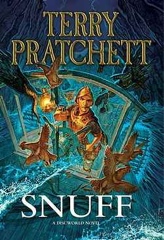
Snuff

By Terry Pratchett
I can't believe that anyone who's not brand new to this blog (and if you are, welcome) would have the slightest doubt that a new Discworld book was a joy to behold. Especially given that at some point, probably sooner rather than later, we will be delivered The Final Discworld book. An embuggerance indeed.
So, a new Discworld. A new Sam Vimes story at that. Of course I enjoyed it. Of the Discworld sub-series I've always liked the Watch best, the police procedural works nicely thank you.
There's a darkness to this book. Snuff. Powdered tobacco? Killing? Both play their part, along with slavery and genocide.
The goblins being enslaved and slaughtered are less than human, pathetic creatures living in squalor, which is surely one of the classic justifications for any manner of inhumanity.
As should come as very little surprise, there's barely a pause between Vimes finding out about such goings on, his resolve to do something about it and his recruiting the first goblin constable. There is then murder, skulduggery and boats to be saved from the suddenly flooded river, all while Sam strives to offend only the people Lady Sybil wants him to and give Young Sam the country holiday he deserves, complete with samples for his growing collection of poo.
It's great fun, moving along at such a rollicking pace that you barely notice the holes in the plot, and when you do, you don't especially care. There is a big unanswered question as to the nature of the supernaturally useful goblin 'Stinky', but the test is tied up pretty well.
It's a new Discworld. That was really all I needed to say.

And sorry, I thought I'd posted this about a month ago...

Sunday, 26 February 2012

We Need To Talk About Kevin

By Lionel Shriver
Am I qualified to comment on this? Neither being a parent nor a depressive, how easily can one relate?
The big question seems to be 'How much can we trust Eva?'
The story is told as a series of letters from Eva to her estranged husband looking over just where everything went wrong with their lives and relationship, something that can be pinned pretty squarely on the birth of their vile child Kevin, now incarcerated for multiple murder in a Columbine style shooting.
Eva seems to have suffered from some form of post natal depression, and Kevin seems to have grown up with the sole aim of identifying anything Eva cared about and destroying it. Obviously writing now, as she approaches the second anniversary of Kevin's massacre, she has plenty of reasons to think herself a failure as a parent, though God knows, she tried.
I remember a Guardian review of the recent film, which I've not seen yet, but will probably catch as soon as it comes on the telly, which was subtitled with the idea that Kevin was Satanic. Since I was already planning to read the book, I only skimmed the article for fear of spoilers.
Satanic. Not a word I would have used. Not really supported by the article either. Still.
Kevin seems a nihilist. He takes no joy except from spoiling things for others. Probably he'd be flagged as EMO these days, another of those trendy descriptions that doesn't mean anything in particular. But Satanic? Doesn't that somehow pass any responsibility onto someone else? If there really were a devil, then knowing that he was leaning over Kevin's shoulder, whispering murderous suggestions into the boys ear, means that the deaths aren't actually his fault. But that would make it far too easy.
Kevin is a nasty child. He hurts things and especially people. He takes delight in upsetting a mother, who while somewhat aloof and dismissive, at least tries. We don't like the idea that children can be nasty, but surely some are, though fortunately rarely this nasty.
(Aside) I am suddenly reminded of people writing about The Wasp Factory, in it's day seen as a very shocking book. I could never quite work out why it was so shocking, save perhaps that they couldn't cope with the idea of a malicious child. (Aside ends)
Back to Kevin. I enjoyed the book. It's a traumatic read, but as it goes on, and the narrative approaches that awful Thursday, becomes increasing gripping. Eva blames Kevin, but blames herself for failing to engage with her child. Would she have redeemed him had she given herself unreservedly in the delivery room. She doesn't know, who could?

I've still not worked out why the writer chooses to style herself as Lionel though. Especially for something like this, where the viewpoint is so very maternal.

Adolf Hitler: My part in his downfall

By Spike Milligan
If there's a pattern to the books being read in the first weeks of 2012 it's that they're things I've had on the shelf for an age and a half, and really should have read before.
So here we have a work that I honestly cannot explain why it's taken me so long to get round to. I picked up the first five volumes of Spike's war memoir trilogy at least five years ago. If not longer. It's an ideal 'slot it in between the hefty tomes' length. It's Spike Bloody Milligan, the greatest humorist of his generation.
And it's been sat there on the shelf getting ignored for half a decade.
I honestly cannot explain why. My tardiness shames me.
I suppose that when published this must have been riding the coat tails of quite a few other things. The Virgin Soldiers, Carry on Sargent, umm, err, surely there must have been others or my theory falls flat. The somewhat humorous look back at one's military experience. When did Fraser start his McAuslan stories?
Still. Not exactly breaking new ground when written, a well trod furrow by 2012.
That's sounds like I'm being horribly critical. Which I don't mean to be. It's biography. You can't condemn a man for having a similar set of experiences to his whole generation, or having had them, for writing about them, especially not when written about with engaging gentle humour.
Spike Milligan was one of the great humorists of his generation, and while the book's certainly not perfect, it's more a collection of incidents than a narrative, I'll definitely be reading the rest. Still don't know why I didn't years ago.

Labyrinth

By Kate Mosse
And the people have spoken, so back to work I go.
Its one of those books I bought years ago, and only just got round to, partly because I was feeling slightly bored by the stream of low quality SF. I seem to remember that it was mightily lauded in its time, honestly can't remember how long it as say in the spare room bookshelf. A volunteer archaeologist working in the mountains south of Carcassonne turns up something unexpected, two bodies in a cave shrine. A teenage girl in Cathar Carcassonne becomes involved in an ancient conspiracy. Past lives, holy grail, though without the Holy Blood, yadda, yadda, yadda.
I read on Wikipedia that Labyrinth possesses the dubious distinction among major best sellers of having the worst 5 to 1 star review ratio out there. I am not entirely sure why, unless there's a meme out there I missed.
I didn't think it a great book, by and stretch of the imagination. The characters are all a bit one dimensional, and I never really believed the 13th century girl being able to multi-class as Herbalist/Fighter. But it's not that bad either. Decent enough action sequences. Give it 2 or 3 stars. And give it to Oxfam.


Saturday, 11 February 2012

And that...

... Dear reader is what I read in 2011.

And dear me, there was some rubbish in there. I honestly did mean to read a Trollope, but damn it, those books are long, and to be honest the logical next book (Phinneus Redux) does not exactly inspire me. I rather enjoyed the first Palliser novel, but the central character of Phinneas Finn did not engage, and a whole book of him trotting back from whatever bog he wound up in? Might be better starting Barchester?

The thing I rarely commented on is format. Almost everything I read in 2011 I read as an ebook. Even books I bought on paper were often read after I downloaded copies. Yes, some books were torrented, though not all, and I'm perfectly happy to defend the idea that downloading a book you have a perfect right to read, so that it can be read in your preferred format is no more theft than copying a CD to your iPod.

I've fallen a bit behind. Writing this in early February I've read more since, and I'm havering slightly over whether to blog them. The odd thing, now that I think about it is how non-genre the 2012 reading has been. One of the things I was consciously doing last year was not to read multiple books by the same author, so I was sort of expecting to have read the same writers next novels by now. Nope. No overlap. They will come. Sir Terry's most recent is next on the list.

Thinks: as far as I know no-one reads this blog. If at least one person comments saying they do, and they'd like me to carry on, I will.

A Rising Thunder

By David Webber

Really. If ever you wanted an example of a series which has become bloated and pointless, this would probably be it.
The series started out well enough. Light American mil-SF, vaguely in the style of Hornblower, complete with a boringly perfect heroine, inventor of every worthwhile tactic in her systems war with their nasty oppressive commie-French neighbours. Oh yes, and has a telepathic cat.
Still, fun enough, if not in the least bit demanding, as she captains a light cruiser, a heavy cruiser, a battlecruiser, etc etc. By this point, about 15 books (depending on just how you count it) in she's Admiral-of-the-Fleet in two different navies, high ranking nobility on several planets, and has a whole tribe of telepathic kittehs. And. The. Whole. Thing. Has. Bogged. Down. So. Badly.
A few of books back the sinister manipulators who set up the original war started to emerge from the shadows, as they tried to set up an even bigger war with the huge, but out of shape, corrupt superpower in the area. Last book the Frenchies worked out that they'd been manipulated into war and declared peace, even offering to help deal with the fleet at that point bearing down on plucky little Manticore.
So here we are. Another hefty tome. A huge battle, even huger than the last huge battle. One that you knew was coming, and it did, about 70% of the way through the book. And guess what? The good guys, the ones who've been fighting a war for the last 20 years turn out to be as 'better' than the bloated corrupt types who've not fought anybody in 200 years as you'd expect.
So, several hundred thousand missiles later the dust settles, and one sides ships are unscratched. And the others aren't there any more.
That's the big event. Hundreds of pages in the inevitable has happened.
So what else is in the book? The sinister manipulators twirl their mustachios a lot. The corrupt bureaucrats act complacent and smug a lot. The shifty local governor who's been assembling a fleet so that he can hive off a little empire, just for himself continues to do so, as he has been for about five books now, without committing himself to anything. Everybody carries on doing the things they do. No surprises. Even the tactic employed at the big walk over battle is one that's been the key to the climactic battles in 3 of the 4 last books.
Fortunately, I need not say 'don't bother'. That it's the 15th of a series is enough to deter any sane person.